

Resumes, cover letters, and interviews matter, but they are job-search skills. Career development requires a broader map for long-term growth and success.
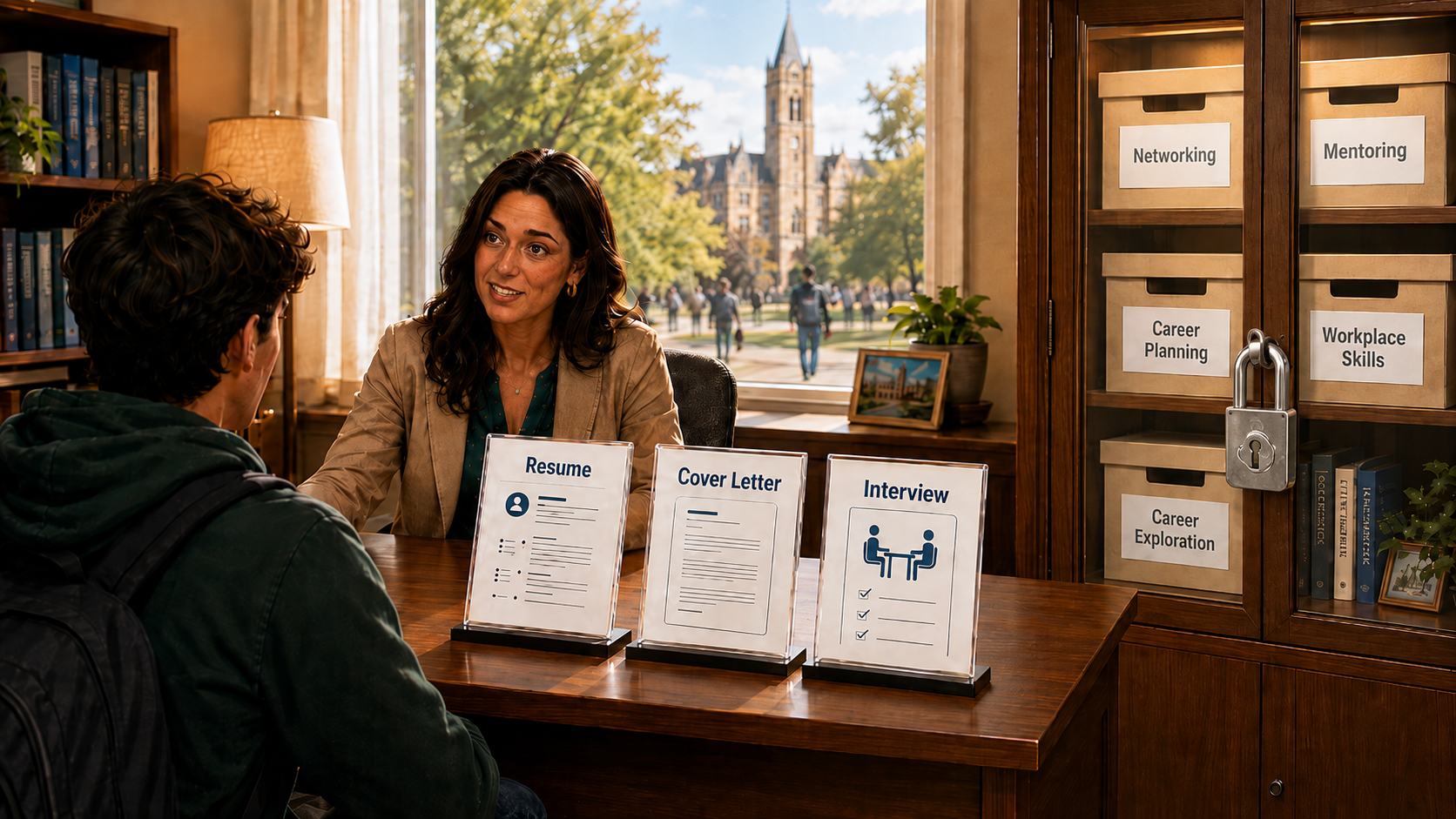
I recently saw a post on LinkedIn where a college talked about a career workshop. Like so many colleges, the “career” training included resume writing, cover letters, and interview training. It’s no wonder that people don’t have career plans; we keep telling them that “career” training is interviewing and resume writing. Colleges are one visible example of a much broader problem: we have allowed job-hunting advice to masquerade as career advice.
This is a double whammy. First, it doesn’t actually provide true career skills, only job-hunting skills. More importantly, it misdefines the skills space. If students are taught that “career skills” means resumes, cover letters, and interviews, they may never realize what is missing. If workers don’t know what they don’t know, they may never actually try to fill in the gap, leaving them less prepared in their careers.
Imagine someone offered “relationship coaching.” You sign up and get workshops on creating a dating profile, swiping, and opening lines. Additional training includes dressing for a date, flirting, and making a good impression. Would that make you a relationship expert?
Clearly, in this example, we’re mislabeling “getting a date” as a relationship. Certainly, you need to get a date in order to have a relationship, but it’s only the first step of something much bigger. Likewise, getting a job is key for your career, but it’s just the first step for any single job, and it’s the course of many jobs over time that is your career.
Once, I overheard my mother talking about dating with a guest at my party. (I used to throw lots of parties pre-COVID, and guests ranged from their 20s to their 70s, so my parents weren’t out of place.) She pointed out to him that he needed to consider not just how much fun someone was, but whether they had shared values and goals and could work together as a family. Yes, you should be attracted to the other person and have fun together, but for the relationship to last decades, more dimensions have to be considered.
I knew this because I was lucky enough to have parents explain it to me. While I know not all parents served as good relationship examples, it didn’t hit me until just then that some people had absolutely no understanding of what it takes to make a relationship work. (That friend got married shortly after and remains married to this day. I can’t say if my mom’s advice had any impact, but I like to think it did.)
While not everyone will talk to someone like my mom about relationship advice, most college students do have access to a career services office and likely will avail themselves of some training. Not every school can offer comprehensive services, but they should be clear about what is needed, even if they can’t provide all of it. Again, mislabeling job-search training as sufficient for career training does a disservice because it incorrectly frames the skills space. I want to clearly define what those services are. This isn’t a comprehensive list, but it gives you an idea of the different job categories.
These skills are about finding a specific job and generally aren’t used outside of a job search.
This training covers skills that are not job-specific. The lessons here cross multiple jobs or even an entire career. They may help when job searching but are at least as important to your career when you’re not job hunting.
These workshops train for specific tools or tactical skills. The application of the knowledge may be helpful at the job and/or career level.
It’s not just higher ed that does this. I see articles, books, podcasts, and “career” coaches all conflate job search with career development. The same critique applies to them. I call out colleges because they have formal, dedicated, and presumably trained staff who should know better. Unfortunately, the wrong mindset can put students on the wrong career-development path. College occupies a unique moment in a professional journey because students are actively seeking such skills, and there’s a blank canvas where the framework, including job versus career boundaries, can be defined.
Again, many career offices focus on job-search topics. It’s understandable, since many undergraduate students primarily focus on finding a job for just after graduation. In my experience, graduate students tend to take a longer-term, more career-oriented view, likely because they were intentional with the upfront investment made by going to grad school.
On the one hand, students are customers of the college, and so the service should respond to their needs. On the other hand, you don’t let a tween pick their own meals. College undergraduate students are quasi-adults; of course, so many of these quasi-adults are okay with Pop-Tarts and ice cream for dinner, so they may be more quasi than adult. More seriously, college students don’t know what they don’t know, and for this reason, it’s important for career services offices to emphasize that job-search skills are not career skills. You can’t force students to take career-planning workshops, but you can make them aware that if they only do job-search workshops, that is not the same as career development.
Thankfully, we live in a world where information is democratized. Even if a college can’t offer training in all those topics, it can guide students to other resources or at least make them aware that there is more out there. No college library has every available book and journal, but librarians can help readers find resources even if they are not on campus. A career office does not need to teach every career skill directly, but it should make clear that resumes, cover letters, and interviewing are only job-search skills. They help students get the next opportunity; they do not, on their own, teach students how to build a career. The one thing schools should not do is define career development so narrowly that they hide missing skills from students. I realize this is often unintentional on the part of the schools, but it’s a disservice nonetheless.


It’s critical to learn about corporate culture before you accept a job offer but it can be awkward to raise such questions. Learn what to ask and how to ask it to avoid landing yourself in a bad situation.


Investing just a few hours per year will help you focus and advance in your career.


Groups with a high barrier to entry and high trust are often the most valuable groups to join.


