

Automation consistently lowers costs and displaces labor, yet society reacts very differently depending on whose job is affected. Creative work is often held to a different standard, raising economic and cultural questions that remain unresolved.
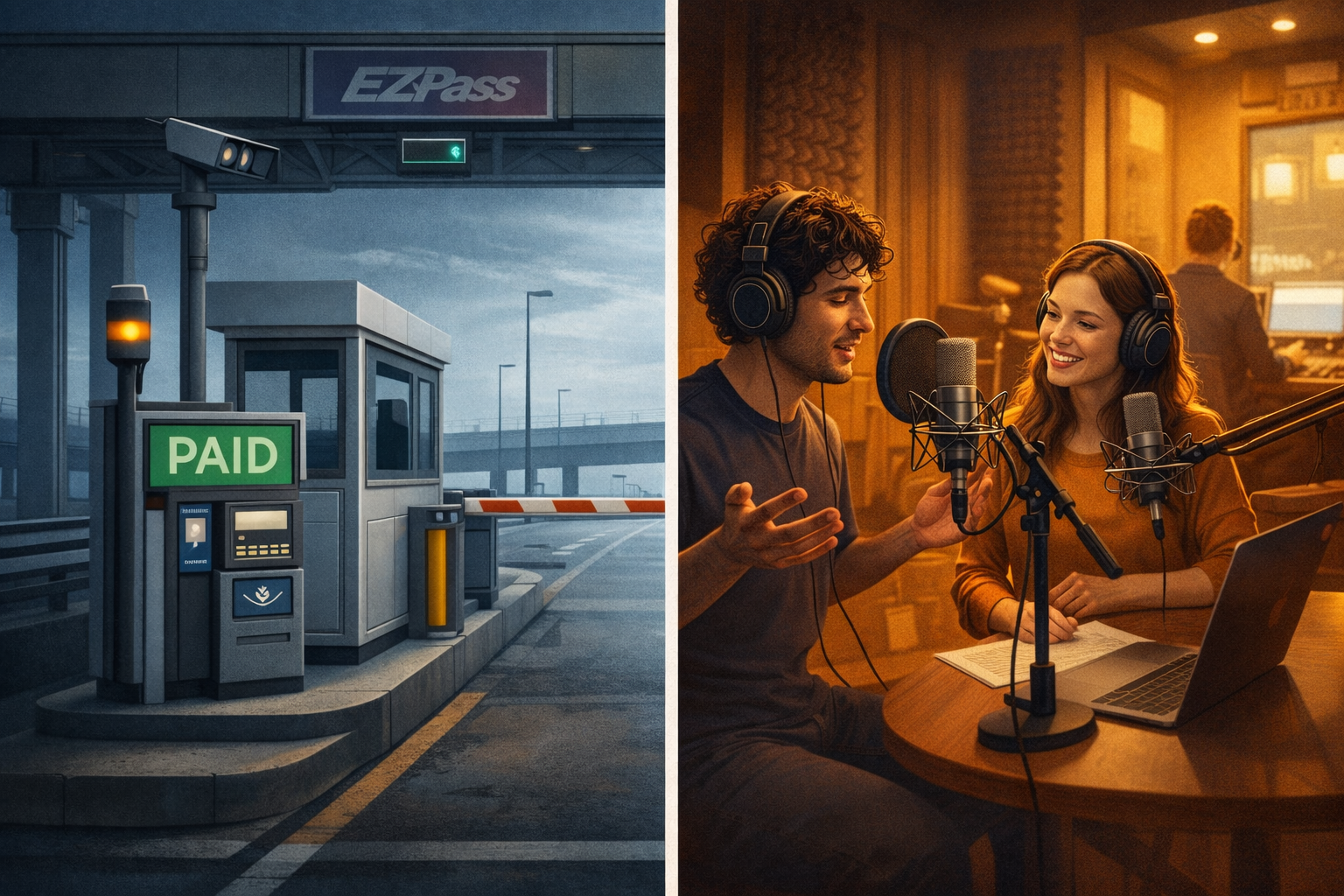
Economics speaks of “creative destruction,” the process by which innovation destroys old jobs and creates new ones. I’ve written about this at length in many of my articles on technology. While everyone values his or her own job highly, how much people are willing to speak up for the jobs of others seems to vary greatly.
For example, iHeartRadio recently positioned itself as a human-oriented media platform. In the article “Real Voices, Real Connection: iHeart Declares Its Content ‘Guaranteed Human.’” Podcast News Daily reports
Artificial intelligence is being used by more podcasters for show production, but listeners of series produced by iHeartPodcasts will now have a flesh-and-blood creator behind them. That’s because iHeartMedia is doubling down on its positioning as one of the last “truly human” mass-reach entertainment platforms. In a memo to staff, Chief Programming Officer Tom Poleman says the “Guaranteed Human” branding will now be used to reinforce the message of real voices and real connection.
This is a surprising 180-degree turn given that iHeartRadio helped pioneer technology-driven programming. As covered in the 2020 article “iHeartRadio Just Replaced Hundreds of Human Workers With ‘Technology and Artificial Intelligence (AI)’” iHeart radio laid off 850 workers and explained it in their January 14th, 2020 press release
As it enters the new decade, iHeartMedia today announced a new organizational structure for its Markets Group as it modernizes the company to take advantage of the significant investments it has made in technology and artificial intelligence (AI) and its unique scale and leadership position in the audio marketplace.
To put it another way, “Officially the change of partners had never happened. Oceania was at war with Eurasia: therefore Oceania had always been at war with Eurasia.” (If you don’t know 1984, you can google the quote for context.)
It wasn’t just the usual layoffs in back-office workers, mind you. Those layoffs included on-air talent like DJs. Do we need DJs? Technically, no. Anyone who has ever DJed a party by hooking up their iPod to a speaker and started playing from a playlist knows this works. Likewise, you don’t need a human to read the copy in a commercial or even sing song lyrics. It’s a choice to use a human. The choice to draw the line today, as opposed to drawing it prior to those layoffs five years ago, is an arbitrary one, and I suspect driven more by profits and margins than any philosophical stand as iHeartRadio would like to have you believe.
More to the point, it’s futile. One of my favorite examples of how people are pro-technology are toll booths. Anyone old enough to remember stopping to hand change to a toll booth collector knows how annoying it was. During rush hour you could wait 3-5 minutes in the queue to do that. We replaced human toll collectors, first with mechanical machines, and later by electronic toll systems. That cost real people real jobs.
Whenever I ask an audience if they would be willing to pay more for tolls, meaning more cost, more time, or both, I universally get “no” as the response. It’s easy to want to be charitable in a vague way, without a direct impact on you when you’re sitting on your couch; we feel for people who lose their jobs. But if you ask someone to add three minutes a day to their daily commute and you’ll find the empathy for displaced workers is overshadowed by their own direct need.
Both people and companies want to pay less money and spend less time. Automation is the answer. Whether it’s mechanical coin collectors at toll booths, home refrigeration eliminating the ice man, or AI lowering the cost of creating an ad because the cost of an actor can be avoided, companies will want that.
Can you think of one job that is protected by law from automation? Take your time. Between all the states and municipalities there may be some, I certainly don’t know every law on the books, but they are few and far between, if any.
There are jobs where humans need to be present, such as a doctor or lawyer, but we allow them to use tools to be more efficient. There are jobs we don’t yet want to give to robots, like armed police. But again they use tools for automating tasks such as NYPD’s CompStat which can predict hotspot areas so they can proactively provide more police. Ultimately, there is no actual law requiring a minimum number of humans. The only time we see a minimum number of humans is in union negotiations, but that’s not a law, that’s a temporary contractual agreement between legal entities.
At the time of this writing on December 16th, 2025 there’s NY Senate Bill S4091 which has been passed to the governor which “Prohibits the operation of N.Y. city transit authority subways or trains without a conductor on board.” Do we still need two train conductors per car? The MTA employees’ union says yes, they are needed to make things run more smoothly and help in emergency situations. Many others say no; the train can be operated by one person and a second just adds unnecessary cost.
Imagine you’re a NY state taxpayer (the MTA is managed and partially funded by the state of NY, not the city of NY). What do you think? Would you want to pay for the second conductor, which, given the revenue losses of the MTA means higher taxes?
If you are arguing that we should not, you’re in the majority; but then why is it ok to get rid of the conductor but not the voice-over artist? If you argue that it's about a difference in skill, then what about automating away accountants, software engineers, data analytics, translators, and others? It’s easy to cry for on-air talent. Far fewer people spoke up when it was the accounting team who was downsized by iHeartRadio a few years ago.
A few centuries ago, the luddites destroyed looms because they turned textile work from a highly skilled profession to one which less skilled workers could do. If you’re wondering how it ended just look up how clothes are made today. Have you heard anyone who has argued that we need to remove technology from clothing manufacturing and make sure more humans are involved? How many people do you feel should be involved in the construction of your car? Would you pay for more of your car to help support those additional workers, instead of cheaper automation?
One reason creative jobs feel different is because of the nature of their work. When we make an accountant more efficient, say by connecting to third-party systems instead of having them type in numbers, we think, “that’s just busy work, and now the accountant can focus on more important tasks.” The same is true for marketers, HR, project managers, etc. It’s traditionally been the busy work that gets automated away. But unlike the rest of us, whose jobs consist of many types of tasks, creative people, like screen actors and voice-over talent, basically do one thing. Yes, they might do research for a role, or promote the show afterwards, but the core of their work is the acting, singing, or reading. When you take that away, there’s not really other parts of the role for them to focus on. The same was true for the toll booth collectors; when the taking of coins went away, so did the job as a whole. This isn’t a moral judgement on the value of the work, but simply an observation of the nature of their jobs. However, the choice to speak up more for creative workers than for toll booth collectors is not based on economics, but perhaps more of a value judgement or emotional hierarchy.
We know the end to this story. No matter how much people will push back on AI taking jobs, if it’s not their job, in the long run, they will take the product or service that’s equivalent in functionality and lower cost when automated. There may be pockets of pushback but historically campaigns like the 1980s “Buy American” push had limited, short-term results, and are swept away by the classic economic force of people wanting to pay less.
For those who disagree, and think lines should be drawn, the question becomes: where? What is the metric by which we say one type of job must be protected even if the economics suggest otherwise? How much is society willing to pay for that? We clearly will not pay a few minutes a day in our commutes. Some people do pay more money for a live performance than a recorded one. Should we simply let the free market decide or should there be protective laws around it? L'académie Française is a French institution whose mission is to protect the French language, even if it creates some degree of friction for society. How much friction will countries accept to protect certain types of work and why those jobs and not others?


It’s critical to learn about corporate culture before you accept a job offer but it can be awkward to raise such questions. Learn what to ask and how to ask it to avoid landing yourself in a bad situation.


Investing just a few hours per year will help you focus and advance in your career.


Groups with a high barrier to entry and high trust are often the most valuable groups to join.


