

When AI learns where to put the X, expertise does not disappear. It moves up the value chain toward judgment, strategy, problem framing, and human alignment.

There’s a famous, albeit apocryphal, story about an engineer.
Back in the 1920s there was an exceptional engineer; after a long and successful career, he retired. Several years later his company contacted him. A very complex but critical machine was broken and none of the engineers could fix it. Would he come out of retirement briefly to solve the problem?
The engineer asked for schematics and spent two weeks reviewing every detail. At the end of those two weeks he grabbed some chalk, walked over to the machine and placed an “X” on it. He said, “Open the machine here and you will find the problem.” They did, and the problem was found and fixed. They thanked the engineer and insisted that he send them a bill.
When they received a bill for the princely sum of $10,000 the company asked him to itemize his charges. He wrote:
One “X” chalk mark . . . . . . . . . . . . . . . . . $1
Knowing where to put the X . . . . . . . . . . . $9,999
The company promptly paid.
We all know where to put the X in our areas of expertise. I got paid as a software engineer because I knew where to put the curly braces and semicolons so the code would compile. Aerospace engineers understand airfoil design and mechanical engineers know the engine heat cycle. My accounting friends know how to mark certain transactions correctly under GAAP standards. Marketers know how to create and monitor ad campaigns, and what metrics to use when deciding whether to sponsor an event. Some of this knowledge comes from schooling, but more often it comes from workplace experience.
But what happens when everyone else knows where to put the X, too? If any engineer at the company could solve the problem, that retired engineer is no longer so special. Has expertise been democratized?
It comes down to what exactly we mean by “placing the X.” Not all Xs are the same. There is a range, moving from mechanical knowledge to diagnostic analysis, through constrained design, and up to strategic planning and organizational execution. AI cannot place all those Xs equally, and as some get commoditized, the opportunities lie with those higher on the value chain.
Knowing where to put the curly braces in programming was a barrier to entry for people who wanted a software engineering job but didn’t know how to code. However, it wasn’t my true value to my employers. Put differently, the mechanical knowledge of getting code to compile made me more valuable than the average person (who does not know how to code), but my real value to the company was rapidly designing and building complex, scalable, durable software systems. Today, you can put the curly braces in the right spot, too, thanks to AI, but that doesn’t mean you can build complex software. Likewise, any mechanical engineer can explain how engines work, as can someone using AI as a guide. But the better engineers can design the right engine given constraints like size, weight, materials, price, and time to market.
Generative AI can help me file legal documents like court motions. It can tell me how to fill out and file a court document. It even helps me find and cite legal precedent. Yes, it has famously hallucinated court cases, but as LLMs continue to improve, they can spend more effort verifying citations and claims, and the probability of hallucinations will continue to diminish, though likely at different rates in different fields. Even though AI can walk me through the mechanics of filing a lawsuit, I’d be very hesitant to use it as a lawyer. It can undoubtedly suggest legal strategy, and that strategy might even sound correct to a layperson like me, but it is unlikely to be as good as advice from a real lawyer. If I was going to small claims court, AI might be sufficient, but for a real lawsuit, it isn’t. Likewise, if someone needs to create a small piece of software to help with something in their job, vibe coding is great. For real, commercial, enterprise software, they’d need an expert just as I would need a lawyer.
In 2026, AI is not guaranteed to place the X correctly. That will change over time, but it is worth understanding the limitations, because as AI moves to each new level of X, it will likely begin with similar problems.
Generative AI is fine for planning your vacation, since the biggest risk is that it gives you the wrong hours for a particular attraction. On the other hand, a study in Nature Medicine, “ChatGPT Health performance in a structured test of triage recommendations” found that ChatGPT was wrong in over 50% of tested medical scenarios. (If you don’t have time to parse detailed medical articles, I recommend the wise and humorous Dr. Bruce Y. Lee’s coverage in Forbes, “ChatGPT Provided Wrong Advice in Over 50% Medical Emergencies Tested.”)
We see such mixed results everywhere. In my own field of software, it sometimes gets the code right, sometimes gets it partly right (e.g., it creates the feature but it's badly designed and will cost you later), and sometimes gets it wrong (but thinks it got it right). Laypeople can’t always tell the difference.
That’s not to say it will always be this way. LLMs are starting to work through problems for longer periods and with more persistence than humans typically can. METR (Model Evaluation & Threat Research, a 501(c)(3)) shows just how quickly the models are progressing. Note that the chart below is a log scale. Today’s X will become tomorrow’s commoditized knowledge.
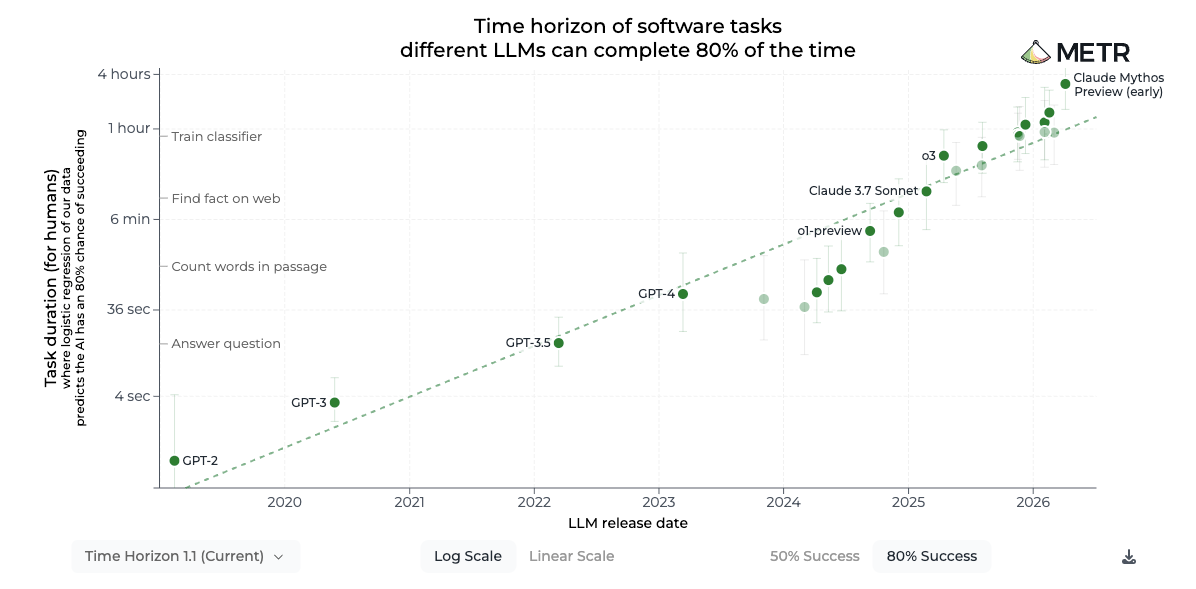
As AI gets better at placing the X at one level, human value will move to the next. At any level, AI may struggle at first, as it has at prior levels. But the endgame is the same: today’s challenges become tomorrow’s routine capabilities. It’s just a question of how quickly we move up the value chain.
This type of advancement in X placement isn’t new. I learned a little machine code in college mostly for historical context as part of my degree; I never used it professionally. Machine code was how people programmed in the 1960s and 1970s. As we developed more modern languages like C, Java, and Python, we abstracted away that knowledge so software experts like me don’t have to know it. I don’t know how to “place the X” of putting values in a hardware register, but I also don’t need to know it to do my job. In other words, we moved people up the value chain as we automated away lower-level knowledge. People who only knew the X of machine code got replaced. Those who understood the higher-level concepts of software engineering continued to be valuable even as machine coding knowledge became commoditized by higher-level languages.
A good, non-generative AI (meaning non-LLM AI) precedent is found in radiology. In 2018, CheXNeXt was able to screen X-rays as well as human radiologists, but in much less time. Many predicted the end of radiology as a profession, but “from 2014 to 2023, the number of radiologists enrolled in Medicare increased 17.3% (from 30,723 to 36,024)” according to the American Journal of Roentgenology. This is despite high turnover in the industry (partially due to high demands during COVID) as noted in the report. Moreover, there is expected to be a shortage of radiologists in the coming years as demand continues to grow (see “The Radiologist Shortage: Rising Demand, Limited Supply, Strategic Response,” “The Growing Nationwide Radiologist Shortage: Current Opportunities and Ongoing Challenges for International Medical Graduate Radiologists” and “Projected US Radiologist Supply, 2025 to 2055”).
There are multiple reasons for the shortage. One is demographic shifts in both the profession and the population as a whole. Jevons-like effects may also play a part: as parts of radiology become faster, cheaper, or more scalable, demand for the broader service can increase. (I provide a detailed discussion and example of Jevons paradox with modern technologies in “How to Know If Your Job Is Safe from AI — Part 1: What History Shows Us About Job Loss and Job Growth.”) In addition, radiologists could shift to higher-value work as more of the grunt work of reading X-rays became automated. This pattern is likely to be replicated in many other fields.
History shows us that automation doesn’t erase the value of domain knowledge; it changes where that knowledge gets applied. The pattern is the same regardless of the source of technological improvement. To understand where human value moves next, we can look at an example from the Industrial Revolution.
The legendary John Henry, the “X-marker” of the days of human strength, lost to a steam-powered rock drill. Human steel drivers were replaced by machines. But that wasn't the end of the story.
Tony Ulwick pioneered the Jobs-to-be-Done approach in the 1990s. His approach points out that no one actually cared about a piece of steel driven into rock; rather, people cared about railroads being built. Humans may no longer drive the steel by hand as John Henry did, but humans still identify where the steel should be driven. In other words, they decide where it makes sense to lay out railroad tracks. Further along the value chain, deciding how to construct such a rail network requires looking beyond the cost of the track itself. There are also issues of local politics, weather, reliability, maintenance costs, speed needs for certain types of cargo, alternative options for key routes, etc. Further still, investors and operators need to consider the railroad versus other options like trucking or shipping, and again, it’s not as simple as just direct cost.
As we move up the value chain, we shift from solving computational problems to judgment problems. Computational problems include connecting your software to a third-party API, managing an online ad campaign, or optimizing track layout. Judgment problems include deciding which service to partner with, deciding which products to promote in an online ad campaign, at what price, and on what schedule, and deciding whether a railroad is the right solution in the first place.
The X-markers of tomorrow won’t be looking at where to fix the problem, but instead asking what problem should be fixed and how to convince people it’s worth fixing. This requires judgment, but also soft skills. Even before the growth of generative AI, knowing what problems to solve and how to properly frame them was often much harder and more important than solving the problem itself.
Those questions will continue to be chipped away at by AI, but in the next decade at least, if not longer, this is where humans will continue to add value. It’s no longer just where to put the X, but whether we should put an X somewhere in the first place, what type of X we need, and how we will know whether it is in a good spot.
Often, the right answer, or even the right question isn’t enough. If you’re in a leadership or management role, you know that you rarely make decisions alone. Even if you have the right answer, you need to get buy-in from others to pursue your approach. Storytelling and sales, networking and negotiating, and communication and team building skills will not only still apply, but start to become the more critical value-add skills of humans.
The value of narrow procedural knowledge is slipping. Domain expertise still matters, but it will be applied further up the value chain: from knowing the answer, to knowing what question matters, how to evaluate the answer, and how to act on it.
In the coming years, using AI, people will be able to write code, create legal contracts, do financial analysis, and perform other tasks that once required years of education and practice. At the very least, AI will drive down the value of those skills and may outright replace some of them (just as the value of driving steel is much cheaper thanks to power tools). To future-proof your career, you need to focus not simply on using your knowledge to reach the right answer, but on knowing how to ask the right questions and how to get others aligned with your ideas. The X is moving, and so must we.


It’s critical to learn about corporate culture before you accept a job offer but it can be awkward to raise such questions. Learn what to ask and how to ask it to avoid landing yourself in a bad situation.


Investing just a few hours per year will help you focus and advance in your career.


Groups with a high barrier to entry and high trust are often the most valuable groups to join.


